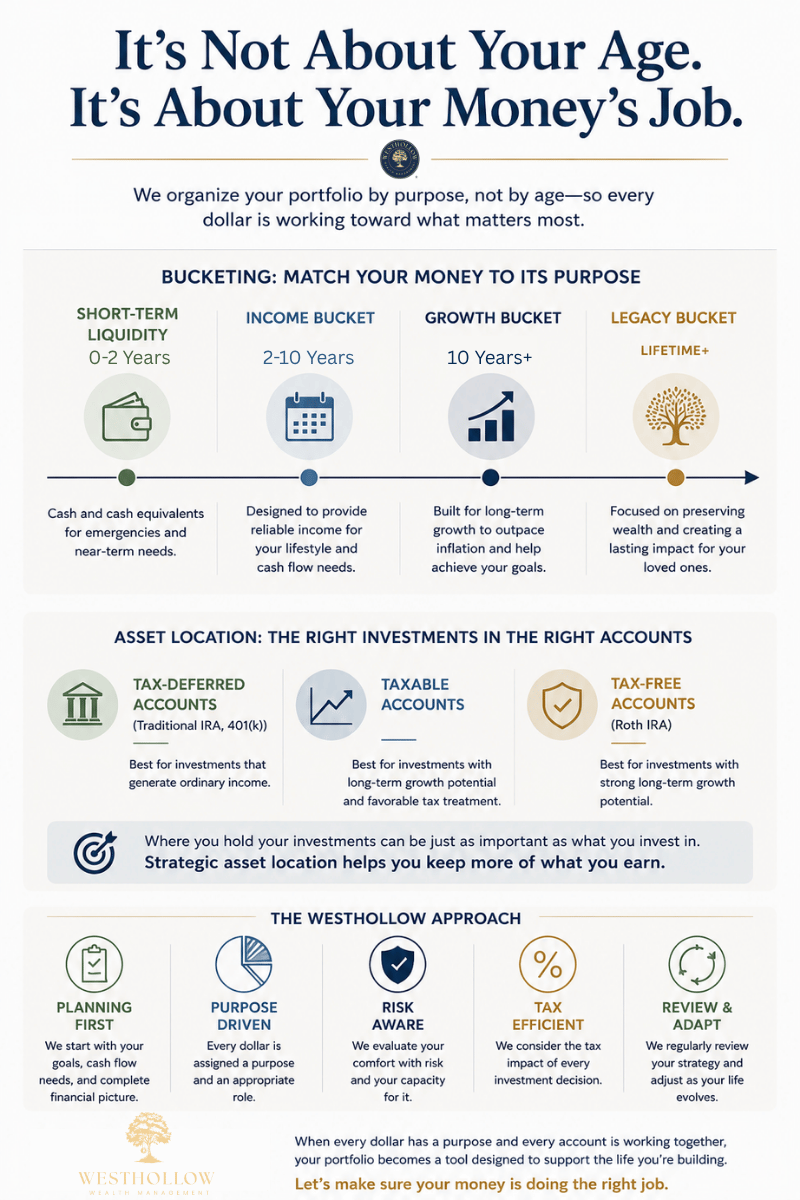
One of the biggest misconceptions in investing is that your portfolio should look a certain way simply because you've reached a certain age.
You've probably heard rules like "subtract your age from 110 to determine how much should be in stocks." While those rules of thumb make for easy headlines, they ignore the factors that actually matter most: what your money is meant to accomplish, when you'll need it, and how the rest of your financial picture fits together.
At Westhollow Wealth Management, we don't start with your age. We start by asking a much more important question:
What is each dollar in your portfolio supposed to do?
That answer drives nearly every investment decision we make.
Every Dollar Should Have a Purpose
Instead of viewing a portfolio as one large pool of investments, we organize it into buckets based on purpose.
Some money is intended to provide income over the next several years. Some is earmarked for long-term growth decades into the future. Other assets may be designated for large purchases, healthcare expenses, or leaving a legacy to your family.
When each bucket has a clearly defined role, investment decisions become much more intentional.
For example, money you'll need in the next few years shouldn't be exposed to the same level of market risk as assets that may not be touched for 20 or 30 years. Likewise, long-term assets shouldn't necessarily be invested too conservatively simply because retirement is approaching. Many retirees will spend 25 to 35 years in retirement, meaning a portion of their portfolio still needs to outpace inflation and continue growing.
The goal isn't simply to own a mix of investments. It's to ensure every dollar has the right job.
Growth and Income Can Coexist
Many investors believe that retirement means moving everything into conservative investments. In reality, retirement often requires both reliable income and continued growth.
That's why we think in terms of growth and income buckets instead of simply asking how much should be invested in stocks or bonds.
Income-focused assets are designed to help provide cash flow for current spending needs while helping reduce the likelihood that you'll have to sell long-term investments during a market downturn.
Growth assets are invested with a much longer time horizon and can remain invested through normal market volatility, allowing them the opportunity to compound over time.
By separating these objectives, clients often feel more confident during periods of market uncertainty because they know their near-term spending needs aren't dependent on what the market does this month.
Asset Location Can Be Just as Important as Asset Allocation
Many investors spend considerable time deciding what investments to own but very little time deciding where those investments belong.
Asset location refers to placing investments in the accounts where they can be most tax-efficient.
For example, investments that generate significant taxable income may be better suited for tax-deferred retirement accounts, while investments with greater long-term appreciation potential may be more appropriate in taxable accounts where favorable capital gains treatment could apply.
The investments themselves may not change, but placing them in the right accounts can improve after-tax outcomes over time.
It's one of the many ways investment management and tax planning work together.
Risk Is About More Than Market Volatility
Risk tolerance questionnaires have their place, but they rarely tell the whole story.
The real question isn't simply whether you're comfortable seeing your account fluctuate.
It's whether your financial plan can withstand those fluctuations.
Someone with a pension, strong cash reserves, and multiple income sources may have a greater ability to tolerate market swings than someone relying entirely on their investment portfolio for monthly expenses.
Likewise, two investors who are both 65 years old may need completely different investment strategies depending on their spending needs, health, tax situation, family goals, and other assets.
That's why we look beyond age and beyond simple risk scores to understand your complete financial picture.
Diversification Still Matters
Diversification remains an important part of managing investment risk, but diversification isn't simply about owning more investments.
It's about owning investments that serve different purposes.
Different asset classes, sectors, investment styles, and income sources can respond differently to changing market conditions. A thoughtfully diversified portfolio helps reduce dependence on any single investment or market segment while supporting the specific role each bucket is designed to fulfill.
Diversification cannot eliminate investment risk or prevent losses, but it can help create a more resilient portfolio over time.
Your Portfolio Should Evolve With Your Life
Investment strategies shouldn't remain static.
A new job, retirement, the sale of a business, an inheritance, changes in tax laws, or caring for aging parents can all affect how your portfolio should be structured.
As life changes, the jobs assigned to your money may change as well.
Regular reviews help ensure your investment strategy continues supporting your goals, your spending needs, and your family's future.
Investing Should Support Your Financial Plan
At Westhollow Wealth Management, we believe investment management is only one piece of a much larger financial picture.
Rather than building portfolios around generic formulas or age-based rules, we design investment strategies around your financial plan.
That means considering how your investments work alongside retirement income planning, tax strategies, estate planning, insurance decisions, and your long-term goals.
When every dollar has a purpose and every account is working together, your portfolio becomes more than a collection of investments. It becomes a tool designed to support the life you're building.
If it's been a while since you've reviewed your portfolio, now is a good time to ask a simple question:
Does every dollar in your portfolio still have the right job?
If the answer isn't clear, we'd be happy to help you find it.